CAPTCHA Bypass Services: How Spammers Beat Your Bot Protection
Inside the multi-million dollar industry of CAPTCHA farms and solving services. Learn how spammers use 2Captcha, Anti-Captcha, and human-solving farms to defeat reCAPTCHA, Turnstile, and hCaptcha at scale.
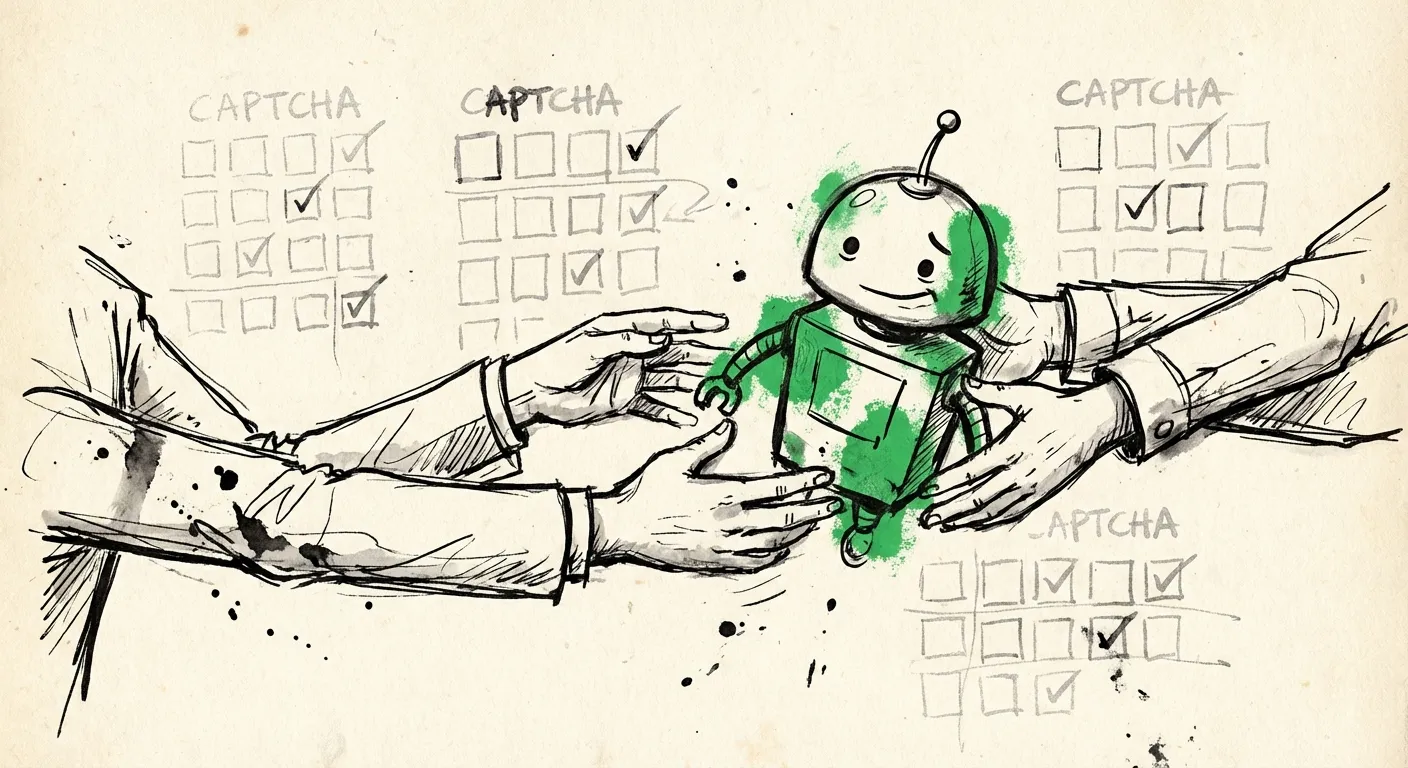
CAPTCHA Bypass Services: How Spammers Beat Your Bot Protection
You added reCAPTCHA to your contact form. Problem solved, right? Every bot should bounce off that puzzle challenge like a fly hitting a window.
Except that’s not what happens.
Your spam folder is still filling up. Fake leads are still flooding in. That contact form is getting hammered by the same garbage submissions as before. What gives?
Here’s the uncomfortable truth: CAPTCHA bypass services are a thriving industry. For as little as $0.50 per 1,000 solves, spammers can route their CAPTCHA challenges through human-solving farms or AI solvers and submit to your forms without breaking a sweat.
Let’s pull back the curtain on how this actually works.
The CAPTCHA Arms Race Is Over (And We Lost)
CAPTCHAs were designed around a simple premise: humans can do things computers can’t. Read distorted text. Identify traffic lights. Click on fire hydrants in a grid of grainy images.
That premise held up pretty well through the 2000s and early 2010s. But two things changed:
-
AI got better. Modern machine learning models can solve text-based CAPTCHAs with over 90% accuracy. Image recognition? Same story. The puzzles that were “hard for computers” in 2010 are trivial for a fine-tuned model in 2024.
-
Human labor got organized. Why bother training an AI when you can pay humans $1 per 1,000 solves? CAPTCHA farms emerged as a surprisingly efficient business model.
The result? According to industry data, roughly half of all passed reCAPTCHAs are now completed by bots using bypass services. Your CAPTCHA isn’t a wall anymore. It’s a speed bump with a toll booth.
How CAPTCHA Bypass Services Actually Work
There are two main categories of bypass services: human-powered farms and AI solvers. Most major services use both.
Human CAPTCHA Farms
The concept is brutally simple. Workers—usually in lower-wage regions like the Philippines, India, Bangladesh, and Venezuela—sit at computers solving CAPTCHAs all day. They earn a few cents per solve, with typical rates around $0.17 per 1,000 basic CAPTCHAs and $1.00 per 1,000 reCAPTCHAs.
These operations can be surprisingly large. Some farms employ hundreds or thousands of workers, distributed across multiple facilities or working remotely from home. The economics work because the pay is so low—workers earn maybe $2-3 per day, but in regions with limited job opportunities, that’s enough to attract a steady workforce.
The technical integration is where it gets interesting. These farms don’t just have people manually copying and pasting. They run sophisticated API-based services that:
- Accept inbound CAPTCHA requests from clients
- Queue challenges and route them to available workers
- Return solutions via API within seconds
- Handle load balancing, worker management, and quality control
From the spammer’s perspective, it’s as simple as making an API call. They never see the humans behind the scenes.
AI-Based Solvers
For simpler CAPTCHAs, human labor isn’t even necessary. AI solvers have gotten good enough to handle:
- Text-based CAPTCHAs (distorted characters)
- Basic image classification challenges
- Audio CAPTCHAs (which were supposed to be accessible alternatives)
- Some reCAPTCHA v2 image grids
The accuracy varies, but 70-90% success rates are common for well-trained models. And since API calls are cheap, spammers can just retry failed attempts until one gets through.
More advanced challenges like reCAPTCHA v3’s invisible scoring and complex multi-step puzzles still typically require human intervention. But the trend line is clear: AI solvers are eating into the human farms’ business model.
The Economics of CAPTCHA Bypass
Let’s talk money. Here’s what spammers actually pay:
| CAPTCHA Type | Price per 1,000 Solves |
|---|---|
| Normal/Text CAPTCHA | $0.50 - $1.00 |
| reCAPTCHA v2 | $1.00 - $2.99 |
| reCAPTCHA v3 | $2.50 - $3.50 |
| hCaptcha | $1.00 - $2.50 |
| Cloudflare Turnstile | $2.00 - $3.50 |
| FunCaptcha/Arkose | $2.50 - $5.00 |
For context: if a spammer is submitting to 1,000 contact forms and each form has a reCAPTCHA, they’re paying roughly $2-3 total. That’s… basically nothing. Even at the high end, a campaign targeting 100,000 forms costs maybe $300 in CAPTCHA solving.
Compare that to the potential value of even a few successful phishing attempts or lead captures, and the math becomes obvious. CAPTCHA bypass is a rounding error in the spam economy.
Volume Discounts Make It Worse
The major services offer steep volume discounts. Spend $2,000+ per day and you’ll get preferential pricing. Large-scale operations can push costs even lower through long-term contracts and dedicated worker pools.
This creates an unfortunate dynamic: the more serious and damaging the spammer, the cheaper CAPTCHA bypass becomes for them. Casual script kiddies might get deterred by the friction of setting up a bypass service. Professional spam operations? They’ve already got accounts with multiple providers and automation running 24/7.
Inside a Bypass Service API
To understand why this is so easy to exploit, let’s look at how the API integration actually works. Here’s the typical flow:
Step 1: Client sends CAPTCHA to service
When a spammer’s bot encounters a reCAPTCHA, it extracts the site key and page URL, then makes an API call:
POST https://api.2captcha.com/in.php
{
  "key": "YOUR_API_KEY",
  "method": "userrecaptcha",
  "googlekey": "6Le-wvkSAAAAAPBMRTvw0Q4Muexq9bi0DJwx_mJ-",
  "pageurl": "https://example.com/contact"
}
Step 2: Service queues the challenge
The service returns a request ID. Behind the scenes, it routes the challenge to an available worker (human or AI).
Step 3: Worker solves it
A human somewhere clicks through the image grid, or an AI model runs inference. Average solve time: 20-45 seconds for reCAPTCHA v2.
Step 4: Client retrieves solution
The bot polls for the result:
GET https://api.2captcha.com/res.php?key=YOUR_API_KEY&action=get&id=12345And receives the token:
{
  "status": 1,
  "request": "03AGdBq24PBCbwiDRaS_MJ7Z..."
}
Step 5: Bot submits the form
The token gets injected into the form’s hidden g-recaptcha-response field, and the submission goes through. From the server’s perspective, it looks like a legitimate human solved the CAPTCHA.
The whole process is trivially automatable. Major bypass services provide official SDKs for Python, JavaScript, PHP, C#, Go, Ruby, and more. There are browser extensions that auto-solve CAPTCHAs. Puppeteer and Selenium integrations. Everything a spammer needs to scale up.
The AkiraBot Case Study
Want to see this at scale? Look at AkiraBot, a spam campaign documented in late 2024.
This Python framework specifically targeted small and medium business websites, focusing on contact forms and chat widgets. The operators used multiple CAPTCHA bypass services (Capsolver, FastCaptcha, NextCaptcha) combined with rotating proxies to evade detection.
The results? Over 400,000 websites targeted. At least 80,000 successfully spammed. All to promote shady SEO services.
This wasn’t some sophisticated nation-state operation. It was just organized spam using commodity tools. The CAPTCHA protections on those 80,000 websites didn’t matter. They got solved and submitted through anyway.
Why Your CAPTCHA Isn’t Protecting You
So where does this leave us?
If half of passed CAPTCHAs are actually bots, and bypass services cost less than $3 per 1,000 solves, what’s the point of adding a CAPTCHA at all?
Honestly? Limited.
CAPTCHAs do provide some value:
- Friction for casual attackers. Script kiddies who can’t be bothered to set up a bypass service will bounce.
- Rate limiting. Even with bypass services, there’s a delay. You can’t submit 10,000 forms per second if each one needs to wait 30 seconds for a CAPTCHA solution.
- Cost imposition. Bypass services aren’t free. Every CAPTCHA adds a small cost to the attacker’s operation.
But for professional spammers? Your CAPTCHA is just another line item in their budget. They’ve already factored it in.
The UX Tradeoff
Here’s what makes this worse: CAPTCHAs hurt your legitimate users too.
Research shows that 65% of internet users find CAPTCHAs annoying. Around 30% have abandoned websites entirely because of CAPTCHA difficulties. Every puzzle you force real humans to solve is friction that pushes away potential customers.
Meanwhile, the spammers sail right through using bypass services.
You’re paying a UX tax that barely affects the attackers.
Beyond CAPTCHAs: Multi-Layered Defense
If CAPTCHAs alone aren’t enough, what actually works?
The answer is layers. No single defense stops everything, but multiple overlapping checks make attacks exponentially harder.
1. IP Intelligence
CAPTCHA bypass services can solve puzzles, but they can’t change where requests come from. Checking IP reputation catches:
- Known spam sources and botnets
- Datacenter and VPN IPs (most legitimate users don’t submit forms from AWS)
- Geographic anomalies (sudden surge from a country you don’t serve)
- Rate limits per IP
2. Email Validation
Spammers use disposable email addresses, recently registered domains, and known spam traps. Validating emails catches:
- Disposable email providers (Guerrilla Mail, 10 Minute Mail, etc.)
- Invalid MX records
- Known spam trap addresses
- Suspicious domain ages
3. Behavioral Analysis
Even with CAPTCHA bypass, bots behave differently than humans:
- Form submission timing (did they fill out the form in 0.3 seconds?)
- Honeypot field triggers (bots fill hidden fields humans can’t see)
- Mouse movement patterns
- Form field interaction sequences
4. Content Analysis
What’s actually in the submission? ML models can detect:
- Spam content patterns
- Link stuffing
- Known spam templates
- Language inconsistencies
5. Network Effects
Every spam submission teaches you something. Aggregate that data across multiple customers and you get a constantly improving spam signature database. That email address that spammed 50 other forms? Flag it before it hits yours.
The FormShield Approach
This is exactly why we built FormShield as a unified API that combines all these signals, not just a CAPTCHA.
When a form submission comes in, we run:
- Fast checks first: Honeypot validation, timing analysis, rate limits. These cost nothing and catch the lazy bots.
- IP intelligence: Reputation scoring, VPN/datacenter detection, geographic analysis.
- Email validation: Disposable detection, MX records, domain age, spam trap matching.
- Content analysis: ML model for quick scoring, escalation to advanced AI for uncertain cases.
- Behavioral scoring: Timing patterns, interaction signals, bot fingerprints.
Each signal contributes to a 0-10 spam score with configurable thresholds. You decide what gets blocked, what gets flagged for review, and what passes through.
No CAPTCHA required. Zero friction for your users. And a much harder problem for spammers to solve than just routing challenges through a $2 bypass service.
import { FormShield } from '@formshield/next';

const formshield = new FormShield({
  apiKey: process.env.FORMSHIELD_API_KEY
});

export async function POST(req: Request) {
  const body = await req.json();

  const result = await formshield.check({
    email: body.email,
    content: body.message,
    ip: req.ip,
    formId: 'contact-form',
    metadata: {
      formLoadedAt: body.loadedAt,
      honeypotField: body.website, // hidden field
    },
  });

  if (result.verdict === 'spam') {
    // Return fake success to not tip off spammers
    return new Response(JSON.stringify({ success: true }));
  }

  // Process legitimate submission
  await saveContact(body);
  return new Response(JSON.stringify({ success: true }));
}
The Bottom Line
CAPTCHAs were a good idea 15 years ago. They’re a deteriorating defense today.
The bypass industry has matured to the point where solving CAPTCHAs at scale is a solved problem—literally. For a few dollars, any spammer can route thousands of challenges through human farms or AI solvers and submit to your forms like they’re not even there.
That doesn’t mean you should remove your CAPTCHA entirely. Some friction is better than none, and you’ll still deter the lowest-effort attackers.
But if you’re relying on CAPTCHA alone, you’re fighting with one hand tied behind your back. The spammers have already adapted. Your defenses need to adapt too.
Multi-layered detection—combining IP intelligence, email validation, behavioral signals, and content analysis—creates a much harder problem for attackers. Each additional check multiplies the cost and complexity of bypassing your forms.
And unlike CAPTCHAs, these checks happen server-side. Your users never see them. No puzzles, no friction, no abandonment.
The CAPTCHA arms race is over. It’s time to fight smarter.