Form Spam and Lead Quality: Why Your Sales Team is Drowning
Spam pollutes your CRM, burns out sales reps, and corrupts your pipeline data. Here's what it really costs.
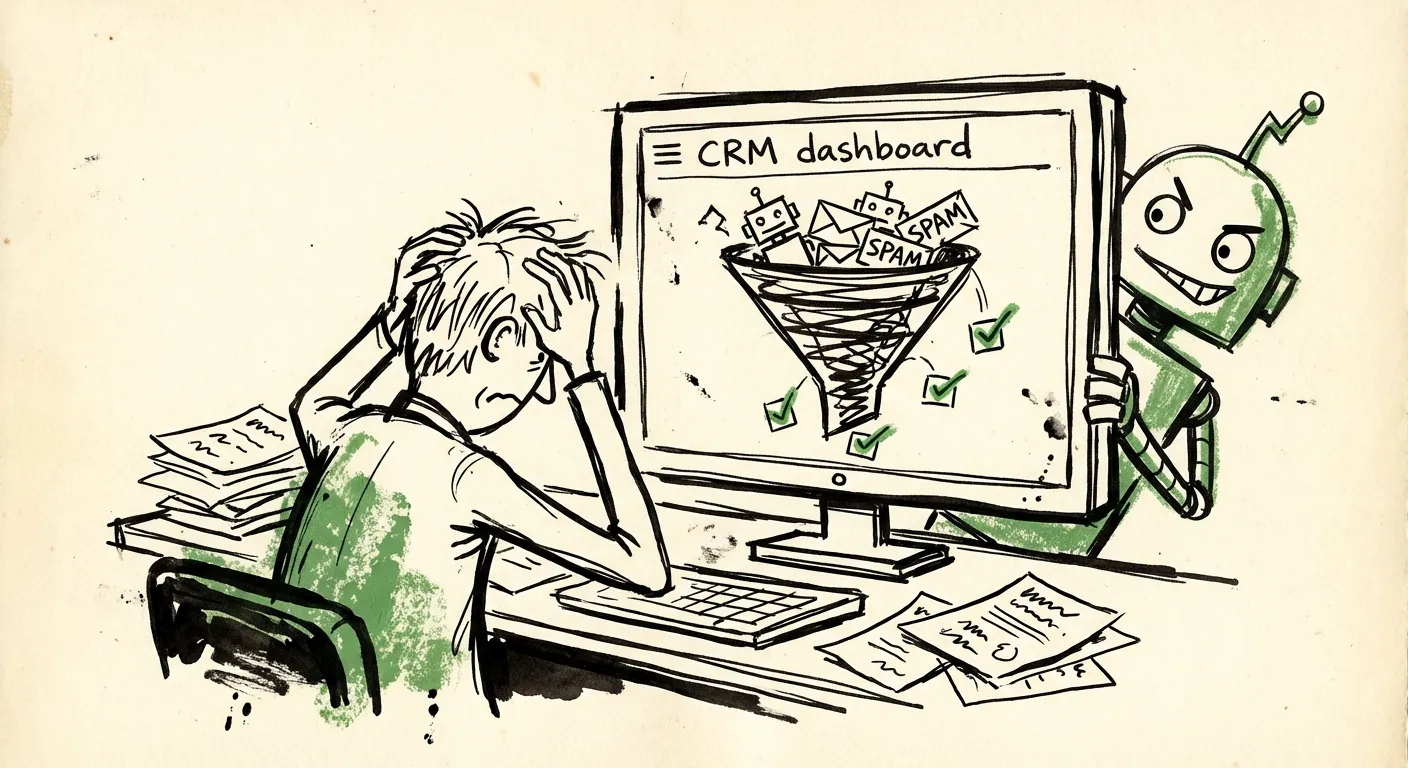
Your best SDR quit last month. She said she was tired of “chasing ghosts.” After two years of hitting quota, her conversion rates tanked. Not because she got worse at her job—because half the leads she was calling were fake.
This is the lead quality crisis nobody talks about. Marketing celebrates record-breaking form submissions. Sales leadership scratches their heads at declining close rates. And somewhere in between, your CRM turned into a digital landfill without anyone noticing.
Form spam doesn’t just waste time. It destroys the entire revenue engine.
The Pipeline Pollution Problem
Here’s what actually happens when spam floods your lead funnel:
A bot submits your demo request form at 2:47 AM. Your marketing automation tags it as a high-intent MQL. Your lead scoring model gives it 85 points because it claimed to be a VP at a Fortune 500 company. The lead gets routed to your best closer.
She spends 15 minutes researching the “company” before the first call attempt. Gets voicemail. Tries again two days later. Again. Sends three follow-up emails. Creates a task to try LinkedIn. Finally marks it dead after burning 45 minutes total.
Multiply that by 50 spam leads per day. That’s 37 hours per week of wasted sales capacity. Per rep.
But the visible time waste is just the beginning. The real damage happens in systems you can’t see.
CRM Corruption Runs Deep
Your CRM isn’t just a database—it’s the memory of your entire go-to-market operation. When spam pollutes that memory, everything downstream breaks.
Lead scoring loses meaning. Your model trains on historical data. If 30% of that data is spam, your scoring becomes noise. Real prospects get deprioritized because they don’t match the patterns of fake leads. The model learns to chase ghosts.
Forecasting becomes fiction. Pipeline reports include phantom opportunities that will never close. You hire based on projected revenue that doesn’t exist. You set quotas that assume a conversion rate diluted by junk.
Attribution goes sideways. Marketing can’t tell which channels actually work because spam concentrates in certain acquisition paths. That Google Ads campaign looks like a winner until you realize 60% of its “leads” are bots. You double down on the wrong channels and cut the ones that were actually working.
One B2B tech company discovered this the hard way. After a CRM audit, they found 18,000 spam contacts accumulated over four years. Those contacts had triggered 340,000+ automated email touches. They’d been nurturing bots while real prospects got lost in the noise.
The cleanup took three months and cost more than $200,000 in consultant hours. They still don’t trust their historical data.
The Sales Team Burnout Spiral
Bad leads don’t just waste time. They corrode morale.
Every spam lead a rep chases is a small psychological hit. Pick up the phone, dial a number that doesn’t work. Send an email that bounces. Research a company that doesn’t exist. It adds up.
After a few months of this, reps develop a form of learned helplessness. They stop trusting inbound leads. They become cynical about marketing’s ability to source quality prospects. The good ones start looking for jobs where the pipeline doesn’t feel like a minefield.
This is measurable. Companies with high form spam rates report:
- 23% lower connect rates (calling garbage numbers)
- 35% more time per lead in early qualification
- 40% higher SDR turnover
- Declining response rates to marketing emails (domain reputation damage)
The turnover number is particularly brutal. Replacing an SDR costs $15,000-$30,000 when you factor in recruiting, training, and ramp time. If spam is burning out your team faster than it should, you’re paying that cost over and over.
Marketing Metrics Become Meaningless
Marketing lives and dies by MQL counts. When form spam inflates those numbers, two bad things happen:
First, marketing thinks they’re succeeding when they’re not. That new landing page test that “increased conversions 47%”? Maybe it just attracted more bots. That webinar that “generated 800 leads”? Good luck finding the 50 real ones.
Second, the marketing-sales relationship deteriorates. Sales complains about lead quality. Marketing points to the numbers. Nobody has visibility into the actual truth because the data is corrupted at the source.
We’ve seen this pattern destroy go-to-market alignment at multiple companies. Marketing gets defensive about their metrics. Sales stops following up on MQLs. The handoff breaks down. Pipeline suffers. Leadership blames both teams.
The fix isn’t more meetings or better SLAs. The fix is cleaning up the data before it enters the system.
The Cost Calculation Nobody Wants to Do
Let’s run some real numbers. Assume a mid-market B2B company with:
- 5 SDRs
- 200 form submissions per day
- 35% spam rate (70 spam leads daily)
- $75/hour fully loaded cost per rep
Direct labor costs:
Each spam lead takes 8-12 minutes of total handling time across the lifecycle (initial research, call attempts, follow-up emails, CRM cleanup). Call it 10 minutes average.
70 spam leads × 10 minutes = 700 minutes = 11.7 hours/day of wasted labor
At $75/hour: $876/day = $319,740/year
That’s more than two fully loaded SDR salaries spent chasing garbage.
CRM cleanup costs:
Someone has to purge the junk periodically. Most companies do quarterly cleanups taking 20-40 hours.
4 cleanups × 30 hours × $75/hour = $9,000/year
(This assumes you’re actually doing cleanups. If not, the pollution compounds.)
Marketing waste:
Every spam lead that enters your nurture flows wastes marketing spend:
- Email sends (ESP costs, typically $0.001-0.01 per email)
- Automation processing time
- Ad retargeting spend on fake audiences
- Content creation for segments that include spam
Conservative estimate: $15,000-$25,000/year
Opportunity cost:
This is the hardest to quantify but often the largest. Every hour spent on spam is an hour not spent on real prospects.
If those 11.7 daily hours were redirected to qualified leads, and your team converts at even 2%, that’s potentially 2-3 additional deals per month. At a $30,000 ACV, that’s $720,000-$1,080,000 in unrealized revenue annually.
Add it up. Even ignoring opportunity cost, form spam costs this hypothetical company $340,000+/year. Factor in lost deals and it’s easily north of a million.
For a detailed breakdown of all hidden costs, see our post on The Hidden Cost of Form Spam.
Why Traditional Defenses Fail
Most companies try to solve this with CAPTCHA. It doesn’t work.
CAPTCHAs create friction that reduces legitimate conversions by 10-30%. And modern spam operators bypass them using human-solving services for under $2 per thousand solves. You’re simultaneously annoying real prospects and failing to stop organized spam.
Honeypot fields catch basic bots but miss sophisticated attacks. Manual review doesn’t scale. Regex-based keyword filters generate massive false positives.
The problem with all these approaches: they treat symptoms, not causes. Spam keeps evolving. Your static defenses don’t.
What works is layered detection that combines multiple signals:
- IP intelligence: Is this coming from a datacenter, VPN, or known spam source?
- Email validation: Is this a disposable address, spam trap, or nonexistent domain?
- Content analysis: Does this message match spam patterns across our database?
- Behavioral signals: Did the form get filled in 0.3 seconds? Was the honeypot triggered?
When you analyze all these signals together, you can identify spam with 95%+ accuracy while keeping false positives under 1%. Real leads flow through. Garbage gets blocked at the gate.
The Lead Quality Transformation
Companies that implement proper form spam detection see immediate results:
Week 1-2: Sales notices fewer obviously fake leads. Connect rates improve because phone numbers are real. The CRM stops accumulating junk.
Month 1: Lead scoring starts becoming meaningful again. Marketing can actually measure channel performance. SDR confidence in inbound leads improves.
Month 3: Historical data cleanup begins. Forecasting accuracy improves. The marketing-sales relationship starts healing.
Month 6: Full data integrity restored. You can trust your pipeline reports. Attribution makes sense. Reps want to work inbound leads.
One of our customers described it this way: “It was like we’d been drinking from a firehose filled with mud. Once the filter was in place, we realized we actually had a decent water source underneath.”
What To Do Right Now
If you suspect form spam is degrading your lead quality, start with an audit:
-
Sample 100 recent leads. How many have invalid email addresses, fake company names, or nonsense messages? If it’s over 10%, you have a problem.
-
Check connect rates. What percentage of phone numbers actually work? If you’re below 40%, spam is a major contributor.
-
Review CRM growth. Is your database growing faster than your team can work it? Exponential growth in contacts often signals pollution.
-
Ask your SDRs. They know. They’ve been complaining. Listen to them.
Once you’ve quantified the problem, the solution is straightforward. Deploy detection that catches spam before it enters your systems. Not after it’s already corrupted your CRM and wasted your team’s time.
Clean Leads, Clear Pipeline
The companies winning in B2B aren’t the ones with the most leads. They’re the ones with the cleanest leads.
A smaller pipeline of qualified prospects beats a massive pipeline of garbage every time. Your SDRs can focus on real conversations. Your marketing metrics actually mean something. Your CRM becomes an asset instead of a liability.
FormShield combines IP intelligence, email validation, content analysis, and behavioral detection into a single API endpoint. One integration, one score, one clear signal whether a submission is real or spam.
No more drowning in garbage leads. No more SDR burnout. No more corrupted data poisoning every downstream decision.
Your sales team has enough real challenges. Chasing ghosts shouldn’t be one of them.
Ready to see what clean lead flow looks like? Try FormShield free with 1,000 requests per month—enough to audit your current spam situation and see the difference firsthand.